Start with your process
We begin with your cell, your formation or test process and the data you already collect.
We listen to batteries during manufacturing, using acoustic emission sensors and AI to reveal activity inside the cell. Our aim is to help manufacturers shorten formation, reduce scrap and identify anomalous cells in real time. The system is a set of passive sensors, data-acquisition hardware and analysis software, configured around your cell and process.
We begin with your cell, your formation or test process and the data you already collect.
Passive sensors listen alongside your existing setup as cells form and age.
Our AI classifies the acoustic signals in real time, helping you understand internal events as they occur.
We synchronise the acoustic record with your existing data, so you can compare formation protocols, spot the cells that warrant a closer look and tune the process on what is happening inside the cell.
Batteries produce acoustic emissions as they form and age. Monitoring those emissions provides insights into internal cell activity alongside the electrochemical and conventional data you already collect.
Passive acoustic-emission sensors sit on the outside of the cell and capture emissions produced by activity inside the battery.
Our AI classifies each individual acoustic hit in real time, so activity can be compared across cells and conditions.
We synchronise the acoustic data with your existing measurements to generate new insight on process optimisation, quality and safety. Compare formation protocols, or identify the cells that warrant a closer look.
Compare · Cell 03 vs batch
Illustration. A smooth, unremarkable voltage curve sits above the classified acoustic hits on one time axis. One interval is highlighted where Signal class 3 hits cluster while the voltage curve stays flat. A comparison card shows cell 03 with a higher hit density than the batch over that interval, marked worth investigating.
The visuals on this page are illustrative. They show how the monitoring works, not measured data from a particular cell.
Sensors mount on the outside of the cell or its fixture, capturing acoustic emissions without sending a signal into the cell.
Monitor internal cell activity as it happens, during manufacturing and operation, to support earlier, better-informed decisions.
Reveal internal activity that voltage and current measurements alone may miss, helping you understand formation and identify anomalous cells.
Designed for different battery chemistries and cell formats, with the sensing setup configured around your cells and process.
The same technique applies across the battery lifecycle, from R&D and manufacturing to batteries in long-term operation, wherever a team needs to know more about what happens inside a cell.
Formation is slow, costly and energy-intensive, with limited visibility into what is happening inside each cell. Compare acoustic activity across cells and formation protocols to identify anomalous behaviour and guide process improvements, helping shorten formation and reduce scrap while maintaining cell performance.
Explore manufacturing and formationBring acoustic activity into your existing test programme, synchronised with the measurements you already record. Compare cells or test conditions and use the differences to shape the next experiment.
Explore monitoring for research teamsSynchronise acoustic activity with battery-management system data, for better-informed health and maintenance decisions and earlier failure detection.
Explore BESS monitoring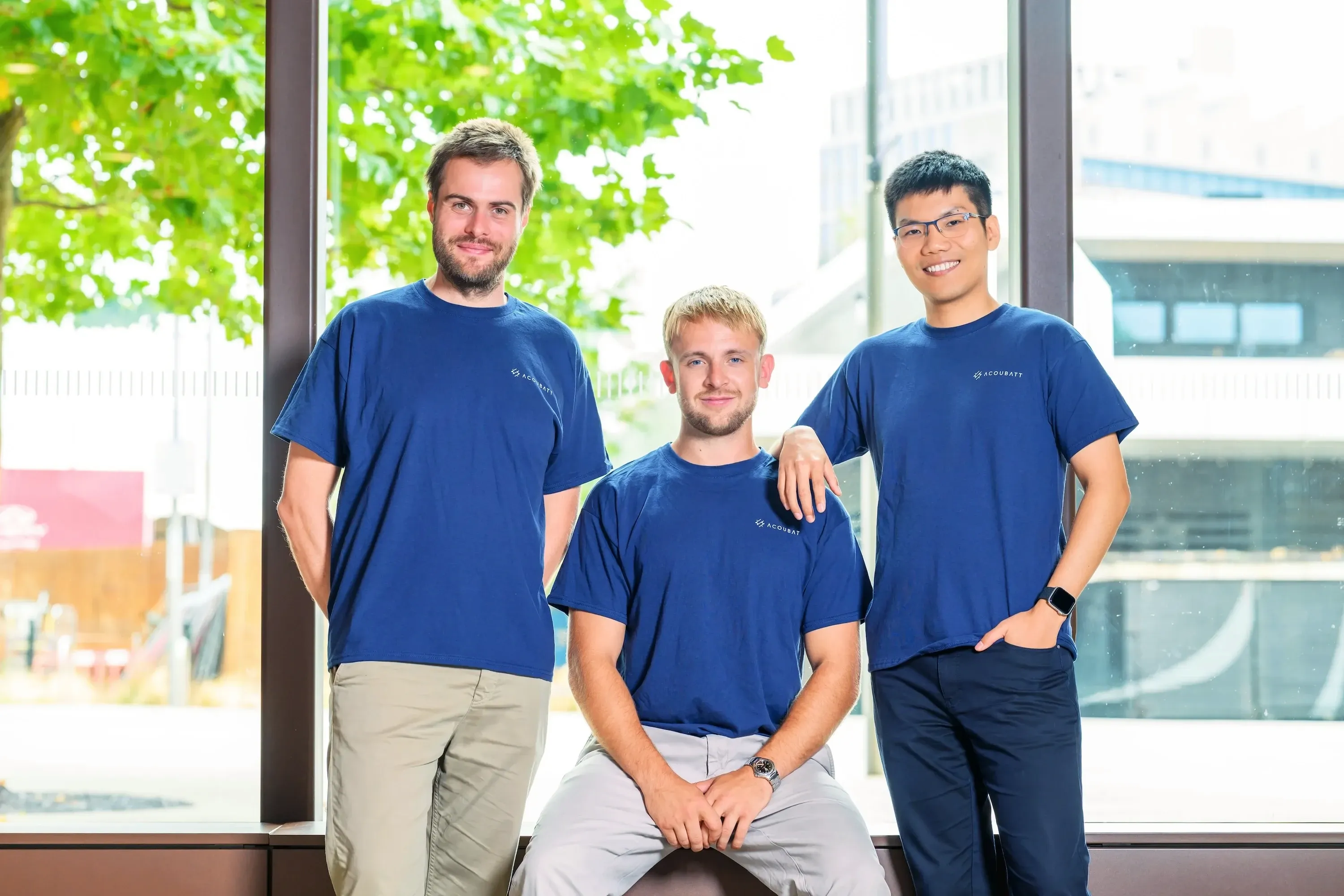
We grew from published battery-acoustics research at UCL. Today we're turning that work into practical monitoring tools for battery manufacturing, R&D and operation.
Meet the teamMost customers start with a demo: sensors and data acquisition fitted to your equipment, the first runs under your existing protocol, and a synchronised acoustic record with findings on which cells differ and why.
Tell us about your cells, your process and the question behind it. If there is a fit, the next step is a short call about your setup and what a demo would involve.